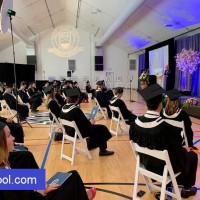

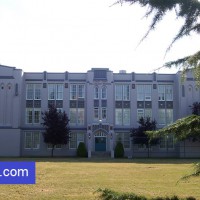
Founded in 1996 by Andrew Chan and Dr. Peter K. Wong, West Point Grey Academy is an independent coeducational K-12 day school located on an 18-acre campus on the Jericho Lands in Vancouver, on the unceded traditional territories of the Musqueam Indian Band, Squamish Nation, and Tsleil-Waututh Nation. The school operates under the leadership of Head of School Stephen Anthony and maintains no religious affiliation, while holding accreditations from CAIS and ISABC. Guided by the mission of “Shaping Lives of Inquiry, Action, and Joy,” the school aims to develop “Bold Thinkers” and “Compassionate Leaders.”
The school employs a child-centered educational approach rooted in attachment theory, growth mindset practices, and inquiry-based learning. This philosophy is designed to challenge students intellectually while fostering character development. The academic program spans the Junior School (Junior Kindergarten–Grade 7) and the Senior School (Grade 8–12), with the latter offering Advanced Placement (AP) courses. To support social-emotional growth and executive functioning, the school utilizes an Advisory program in the Senior School. The broader curriculum includes outdoor education, design and engineering, Indigenous Education programs, academic support services, and modern language instruction in French, Mandarin, and Spanish, alongside university and career counselling.
Students engage with a diverse range of activities that encourage participation in the arts, athletics, and service. The school features comprehensive programs in visual and performing arts, and an athletics program that ranges from foundational physical education to competitive sports. Leadership development is further supported by initiatives such as the PEAKS program (Personal growth, Empathy, Ambassador, Knowing, Stewardship), service opportunities, and specialized offerings including the First Responders Program, Global Online Academy, Duke of Edinburgh's International Award, Work Placement Program, Wilderness Pursuits Program, and the Orton-Gillingham Tutoring Centre.
Admissions are competitive, requiring an assessment and interview process, and applicants must demonstrate English proficiency as the school does not offer ELL or EAL programs.
For the 2026-2027 school year, tuition is $33,300 for JK-Grade 12. New students are subject to a nonrefundable $350 application fee, a $250 reapplication fee, and a $3,500 one-time entrance fee, with an additional $4,500 required for non-British Columbia residents. Tuition covers workbooks, textbook rentals, classroom supplies, field trips, and most outdoor education trips and club activities; costs for uniforms, required devices, and extended cocurricular trips are excluded.
Selecting an educational environment is a significant decision that involves evaluating how a school’s philosophy, community culture, and curricular offerings align with a child’s individual needs. Prospective families often find it helpful to look beyond academic metrics by considering how a school approaches social-emotional development, faculty mentorship, and the integration of extracurricular activities. Observing daily interactions between students and teachers can provide valuable insight into the school’s pedagogical approach and commitment to fostering a supportive learning environment. Additionally, families should consider the long-term benefits of a school’s specialized programs, such as leadership initiatives or inquiry-based learning, and how these experiences prepare students for future transitions. Engaging in thorough research regarding the school’s mission and operational values ensures a clearer understanding of how the educational journey will support a student’s personal growth and academic trajectory over time.
Cultivating critical thinking skills within educational settings equips students to analyze complex information, evaluate diverse perspectives, and construct reasoned arguments rather than simply memorizing facts. By encouraging learners to question assumptions, investigate underlying causes, and apply logical reasoning to real-world problems, schools help build intellectual independence and adaptability. This analytical mindset supports students as they navigate unfamiliar subjects, collaborate on multidisciplinary projects, and make informed decisions across academic and personal domains. Integrating these cognitive strategies into daily coursework allows learners to develop the resilience and discernment needed to address multifaceted challenges throughout their educational journey and beyond.
Managing school stress is an essential component of student well-being, helping learners maintain balance amidst demanding academic schedules and extracurricular commitments. Educational environments often implement proactive support systems, such as advisory periods, counseling resources, and structured mindfulness practices, to help students navigate pressures related to coursework and assessments. Beyond institutional programs, effective stress management involves encouraging healthy lifestyle habits, including adequate sleep, regular physical activity, and balanced time management. When students learn to recognize early signs of burnout and develop practical coping mechanisms, they are better equipped to handle academic challenges with resilience. Cultivating open communication between students, families, and educators also creates a supportive network that fosters both mental health and long-term academic success.